Performance marketing services are the work an agency or specialist does to run advertising that is measured, and steered, by a specific action: a click, a lead, a phone call, an app install or a sale. In practice that covers conversion tracking, building and running campaigns on Google, Meta and similar platforms, making the ads, improving the page each ad sends people to, and reporting what every rupee brought back.
Most explanations stop at that definition and a list of channels. This guide covers what they leave out: what an agency should do for you each month, how Google and Meta really charge (it is rarely "only when you get a result"), what the service costs in India in 2026, and five lessons from big advertisers who tested their own spending in public. The worked examples use made-up businesses called XYZ so the arithmetic is easy to follow. The big-company examples are real, and each one links to its source.
I have run digital marketing for more than ten years. The sections below follow the questions people search for most about this service, from what an agency actually does to whether it is worth the money.
Performance marketing services in plain words
Performance marketing is advertising you can count. Each ad is tracked from the moment someone sees or clicks it to the action you care about, so you know what a lead or a sale cost and can move money towards whatever brings them in most cheaply.
The idea is much older than the internet. A line usually credited to the Philadelphia shopkeeper John Wanamaker goes: "Half the money I spend on advertising is wasted; the trouble is I don't know which half." Quote Investigator has never found proof that Wanamaker said it, and the earliest version it traced is from a 1919 speech. The complaint is real all the same, and performance marketing is the industry's answer to it: measure each ad and you can find the wasted half and switch it off.


A performance marketing service is that measurement work done for you. You hire an agency, a freelancer or an in-house team to plan, run and report on paid campaigns against a number you both agree on, such as cost per lead or return on ad spend.
What a performance marketing service includes
Agency pages usually list channels: Google Ads, Meta ads, YouTube and so on. That tells you where the ads run and very little about the work. Here is the work, in the order it should happen.
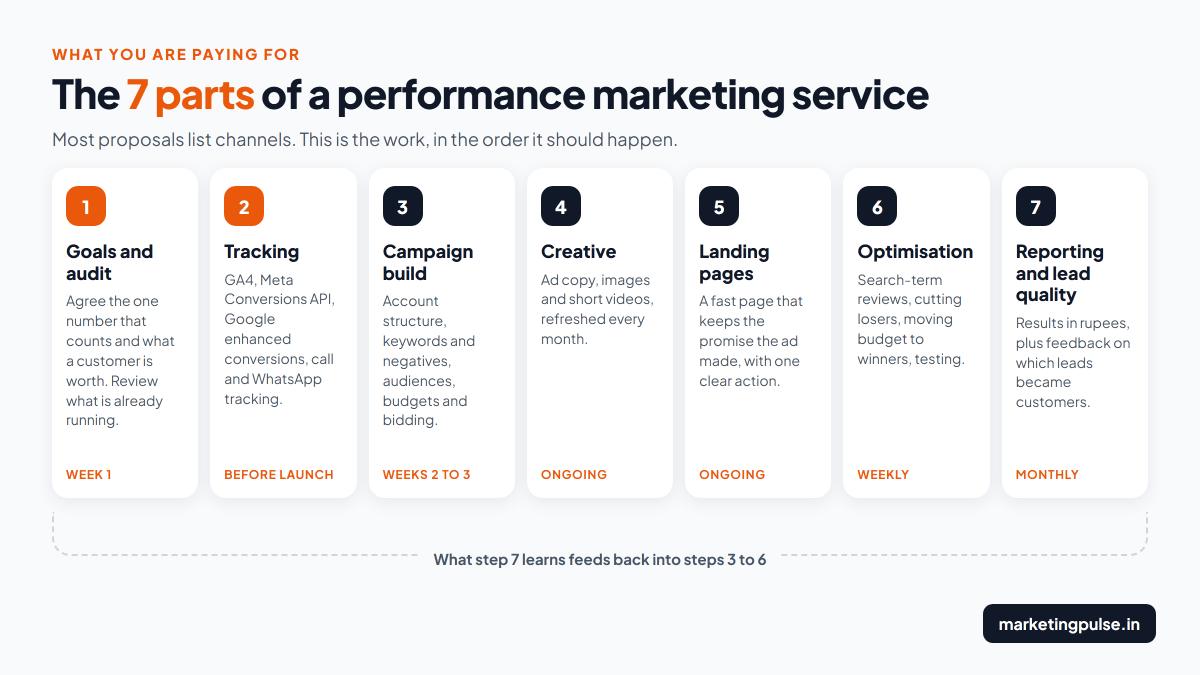
- Goals and an audit come first. Agree on the one number that matters (cost per lead, cost per sale or return on ad spend), work out what a customer is worth to you, and review anything already running. An audit of an existing account looks for money going to searches that can never convert, such as job seekers clicking a company's ads.
- Tracking means conversion tracking in Google Analytics 4 and in each ad platform, Meta's Conversions API, Google's enhanced conversions, and tracking for phone calls and WhatsApp chats. Nothing after this step can be judged without it.
- The campaign build covers account structure, keywords and negative keywords, audiences, budgets and bidding on each platform.
- Creative is the ad copy, images and short videos. On Meta in particular the platform now chooses most audiences automatically, so the ad itself does much of the targeting and a good service produces new ads every month.
- Landing pages are where the ads send people. A fast page that repeats the ad's promise and asks for one action can lower your cost per lead without any change to the ads.
- Optimisation is the weekly or fortnightly routine: reading search terms, pausing what loses money, moving budget to what earns it, and testing new ads and pages.
- Reporting and lead quality close the loop. You should get a monthly report in rupees (spend, leads, cost per lead and, where you can track them, sales) and a simple way for your sales team to mark which leads were real, so that information goes back into the campaigns.
If a proposal covers only the campaign build and optimisation, you are buying campaign management. That is one part of a performance marketing service, so ask who is responsible for the other five.
Do you only pay when you get results?
Nearly every definition of performance marketing says you pay only when a click, lead or sale happens, and Google's own AI summary for this search says the same. On Google and Meta, billing works differently.
| Where the ad runs | What you are charged for | Can you pay only per lead or sale? |
|---|---|---|
| Google Search | Each click, priced in an auction | No. Google lets advertisers pay per conversion only in Display campaigns, and only with more than 100 conversions in the last 30 days (Google Ads Help) |
| Facebook, Instagram and click-to-WhatsApp ads | Impressions, link clicks or video views, depending on the campaign objective (Meta Business Help Centre) | No |
| Affiliate programmes and CPA networks | A commission on each sale, or a fee per lead | Yes. This is the original pay-per-result model; Amazon opened its Associates programme to websites in 1996 (ClickZ) |
| Influencers on a commission deal | A share of the sales made through their code or link | Yes, if you negotiate it that way |
So the word "performance" describes how the spend is measured and steered. On Google and Meta you still pay for attention and clicks, and the agency's job is to turn them into results at a cost you can live with. If someone offers to run Google or Meta ads for you on a pay-per-lead basis, they are carrying the click cost themselves and pricing it in, so ask what each lead would cost if the same ads ran in your own account.
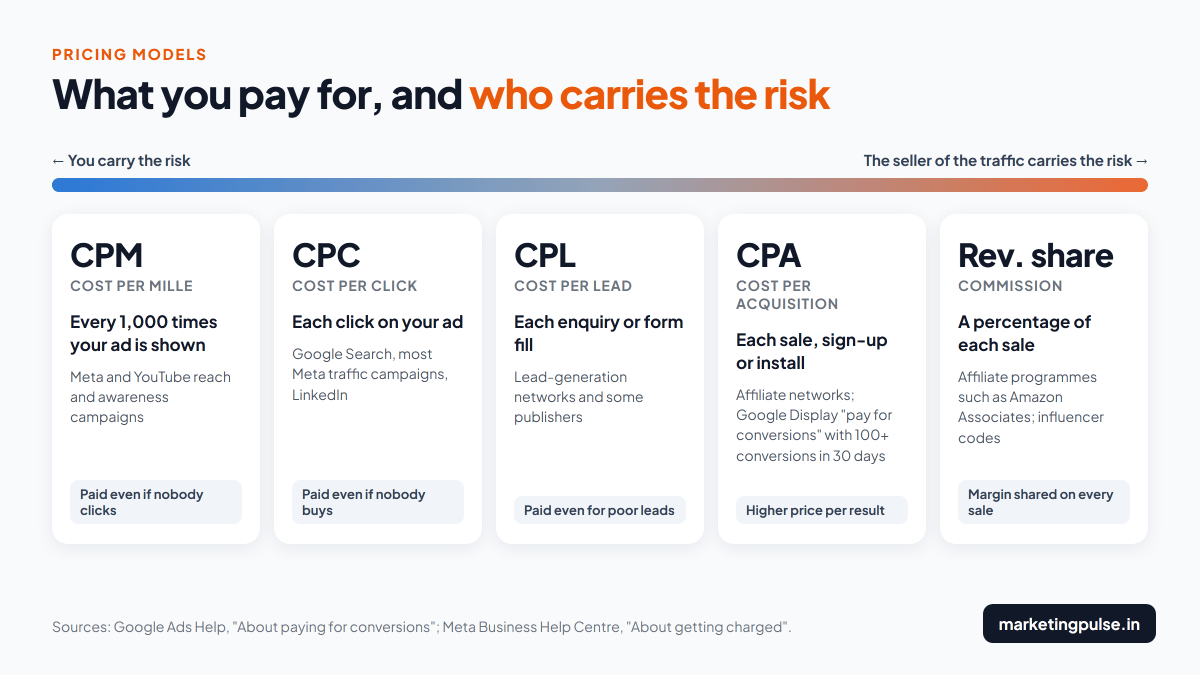
The abbreviations turn up in every proposal. CPM is the cost per thousand impressions, CPC the cost per click, CPL the cost per lead, CPA the cost per acquisition (a sale or sign-up) and CPI the cost per app install. The further right you move on that scale, the more risk shifts to whoever sells you the traffic, which is why pay-per-sale deals come with a higher price per result or strict conditions.
The channels, and where India's ad money goes
Performance campaigns can run anywhere that tracks what people do after seeing an ad. In India most budgets go to a short list.
| Channel | Best for | Worth knowing |
|---|---|---|
| Google Search ads | People already searching for what you sell, like "packers and movers near me" | Captures demand that already exists |
| Performance Max (Google) | Online stores and lead businesses with reliable conversion data | One campaign runs across Search, YouTube, Display, Gmail and Maps, with less control over where each ad appears |
| YouTube ads | Products that need showing or explaining | YouTube ads could reach 500 million people in India in late 2025 (DataReportal) |
| Facebook and Instagram ads | Creating demand among people who are not searching yet: local offers, fashion, education, events | Instagram ads could reach 481 million people in India and Facebook ads 403 million (DataReportal) |
| Click-to-WhatsApp ads | Buyers who want to ask a question before they buy | Tapping the ad opens a WhatsApp chat with your business (Meta) |
| LinkedIn ads | B2B decision makers | Targeting by job title, company and industry; 170 million members in India (DataReportal) |
| Marketplace and quick-commerce ads | Brands selling on Amazon, Flipkart, Blinkit and similar apps | E-retail ad spend in India reached ₹17,601 crore in 2025 (dentsu-e4m) |
| Affiliates and influencers on commission | Online stores and apps that know their margins | The only channels where paying per sale is normal |
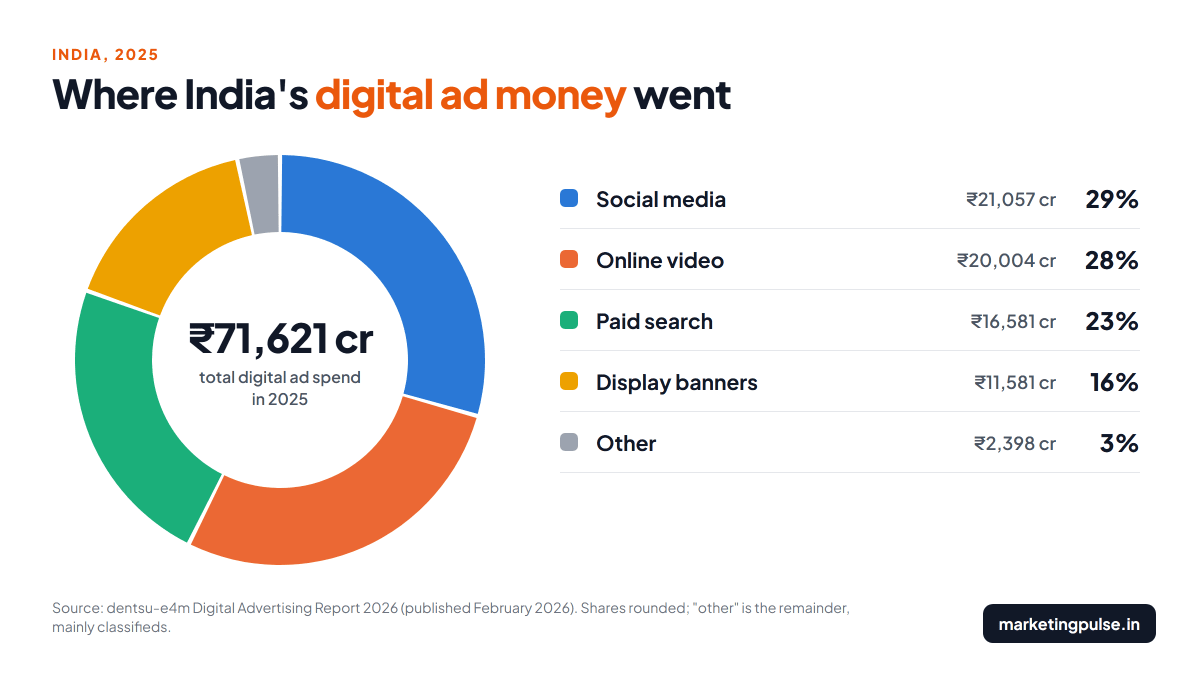
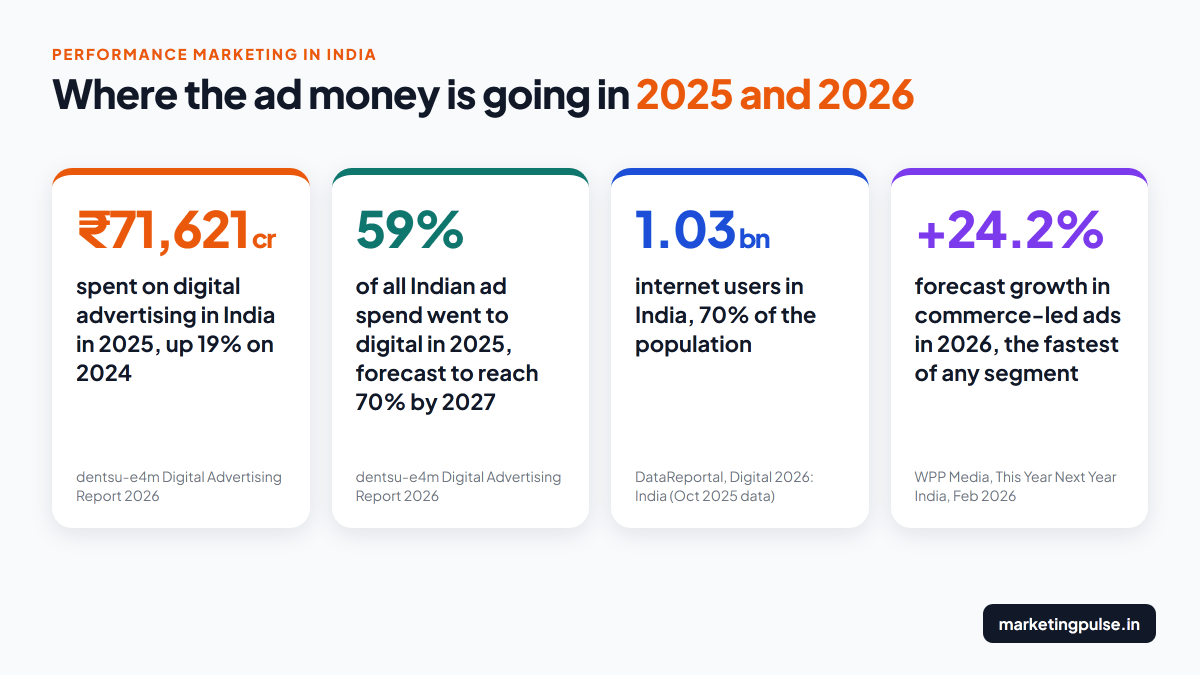
Two forecasts published in February 2026 point the same way. dentsu expects digital to grow from 59% of Indian ad spend in 2025 to 70% by 2027. WPP Media expects commerce-led advertising (retail media, quick commerce and social commerce) to grow faster than any other segment in 2026, and its India report says growth is "increasingly being dictated by measurable outcomes rather than impressions" (Storyboard18).
- Commerce-led advertising24.2%
- Other digital formats11.1%
- Outdoor and cinema8.9%
- AI search, voice and agents8%
- Print4.4%
- Television3.1%
- Audio1.5%
Source: WPP Media, This Year Next Year India, February 2026, via Storyboard18.
How performance marketing differs from digital, brand, SEO and affiliate marketing
| Term | What it means | How it relates to performance marketing |
|---|---|---|
| Digital marketing | Any marketing done online, paid or unpaid | Performance marketing is the paid, measured part of it |
| Brand marketing | Building recognition and preference, so people think of you when they need what you sell | Works over months and years, and tends to make performance ads cheaper over time (see strategy 3) |
| Affiliate marketing | Partners promote you and earn a commission on each sale | One channel within performance marketing, and the one that is truly pay per result |
| SEO | Earning unpaid rankings on Google | No cost per click, but measured the same way; results build slowly and last |
| Growth marketing | Testing across the whole customer journey, including onboarding, pricing and retention | Uses performance marketing to win customers, then works on keeping them |
| Social media marketing | Posting and community management on social platforms | Organic posting falls outside performance marketing; paid social ads with tracking fall inside it |


Which is better, SEO or performance marketing? They solve different problems. Ads put you in front of buyers this week and stop the day you stop paying. SEO takes months to work and keeps bringing visitors without a charge per click. Many businesses need both: ads for enquiries now, and SEO so the cost of each enquiry falls over time. If the budget forces a choice, start with ads when you need sales within weeks and can fund the ad spend, and start with SEO and your Google Business Profile when the budget is small and you can wait. Our guide to the seven types of digital marketing compares every option.
Strategy 1: measure the sales your ads add
You do not have to take any agency's word for what works, ours included. Several of the world's largest advertisers have tested their own spending and published the results, in an academic study, court filings and company reports. The five strategies below come from those tests.
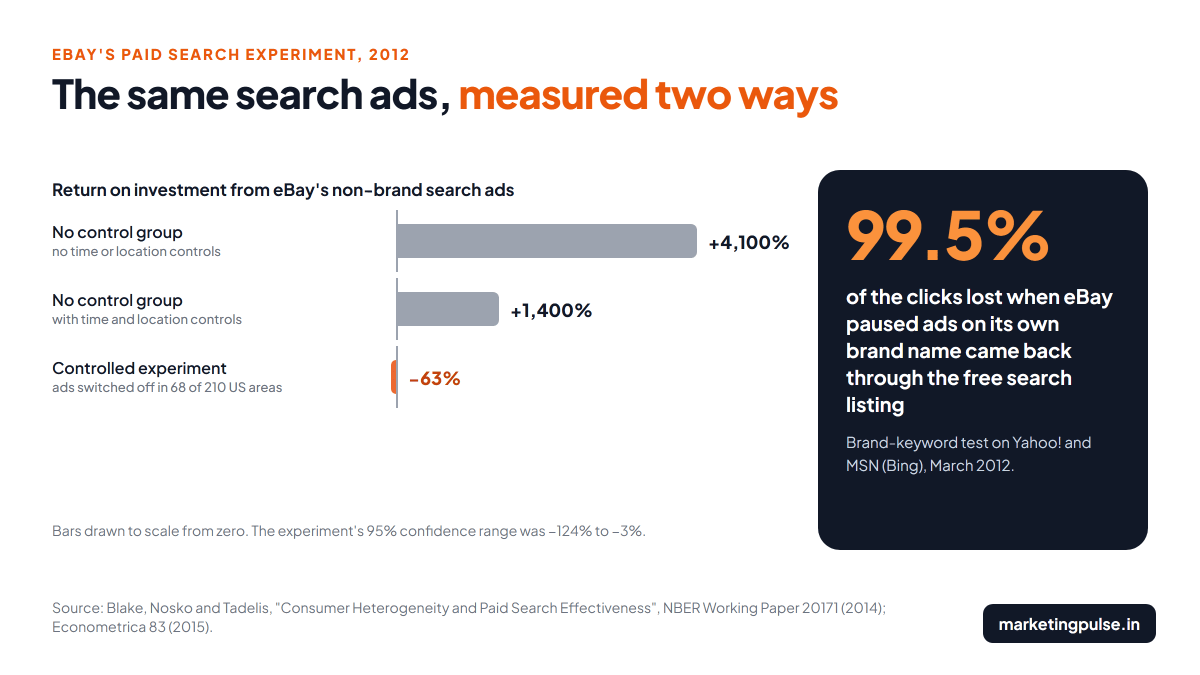
The best-known test comes from eBay. In 2012 its economists switched off non-brand search ads for 60 days in 68 of the 210 advertising regions of the United States and compared sales with the regions where the ads kept running. The results were published in Econometrica in 2015.

Two findings matter for any advertiser. Ads on eBay's own brand name did almost nothing: when eBay paused them on Yahoo! and Bing, 99.5% of the lost clicks arrived through the free listing instead. For other keywords, the ads did bring in new and occasional shoppers, but most of the money went on regular customers who would have bought anyway. An estimate without a control group put the return at more than 1,400%. The controlled experiment measured it at minus 63%.
The conversions an ad platform reports are a different thing from the sales your ads caused. Someone who was going to buy anyway and clicked an ad on the way still counts as an ad conversion. Measuring the difference used to need a large budget, but in 2025 Google cut the minimum for its incrementality experiments from about $100,000 to $5,000 (Search Engine Land). A smaller business can run a rough version for nothing: pause the ads on your brand name, or in one city, for two to four weeks and watch total enquiries in your own records.
Strategy 2: check who is taking credit for your conversions
Uber found out what over-counting costs. Kevin Frisch, its former head of performance marketing, has said Uber switched off $100 million of its $150 million yearly app-install advertising "and basically saw no change" in the number of installs (Inverse). Ad networks had been taking credit for installs that would have happened anyway, in some cases through apps that faked a click on an Uber ad moments before someone installed Uber on their own. Uber took ad networks to court, and one of them, Phunware, agreed in October 2020 to pay $6 million to settle, according to Phunware's filing with the US Securities and Exchange Commission.
Few Indian businesses spend at Uber's scale, but the same problem appears on small budgets: Display ads placed in low-quality mobile apps, lead forms filled with fake numbers, and networks paid per install or per lead that count the same person twice. The defence is ordinary checking. Read the placement report and exclude apps and sites whose clicks never turn into enquiries, compare the leads a platform reports with the leads your team actually spoke to, and be suspicious of any channel whose results look far better than everything else you run.
Strategy 3: keep part of the budget for brand
The largest body of evidence here comes from Les Binet and Peter Field, who studied campaigns entered into the UK's IPA Effectiveness Awards. In The Long and the Short of It (2013) they found that consumer brands tended to get the best results when about 60% of the budget built the brand and 40% went on sales activation, which includes performance ads. Their later study, Effectiveness in Context, put it at 62:38 (IPA). For B2B companies the figure was 46% brand and 54% activation (LinkedIn B2B Institute).

Airbnb is the best-known recent case. When travel collapsed in 2020 it paused performance marketing, and its annual report shows spending on brand and performance marketing fell by $661.8 million that year, $540.5 million of it from performance marketing. The same report says the strength of the Airbnb brand lets it be "less reliant on performance marketing". Chief executive Brian Chesky later told investors the company had kept about 95% of its traffic, and Airbnb made the shift permanent (Campaign).


Procter & Gamble moved money for a different reason. In 2017 it cut $200 million of digital advertising after viewing data showed many of its ads were not reaching the people it wanted, put the money into TV, audio and e-commerce media, and said its reach rose 10% (GCI Magazine).
These are famous brands. A new business with no name recognition cannot switch off its ads and expect the traffic to stay. For a small business, brand building can be as simple as a complete Google Business Profile with steady reviews, useful YouTube videos and consistent social posts, which can make people more likely to click your ad and choose you over the name next to it. The 3-3-3 rule is a simple way to plan that mix without spreading a small budget thin.
Strategy 4: test one change at a time, and keep testing
Booking.com is the standard example of testing at scale. Harvard Business School professor Stefan Thomke, who studied the company for his book Experimentation Works, describes it running experiments "by the tens of thousands", with about three quarters of its core staff able to launch a test themselves (Harvard Business School Working Knowledge). One of his examples is a single drop-down menu at checkout: Booking tested a clearer label against the original and kept it because it improved the site's main metric.


Borrowing the habit does not need Booking's traffic. In an ad account it means changing one thing per test (the offer, the headline, the first three seconds of a video or the landing page), giving each test enough budget to reach a clear result, and writing down what won so nobody repeats a losing idea six months later.
A common way to budget for this is the 70/20/10 rule: roughly 70% of spend on campaigns that already work, 20% on improving them and 10% on new ideas that may fail. Coca-Cola's marketing team made the rule famous for content planning in its Content 2020 strategy (WARC).
Strategy 5: tell Google and Meta which leads became customers
Google's and Meta's bidding systems chase whatever you count as a conversion. Count every form fill and they will find people who fill in forms, including people who never answer the phone. Send back which leads became paying customers and they can look for more people like those.
Google calls this offline conversion import, and enhanced conversions for leads is its newer version. You upload qualified leads or sales from your CRM; Google accepts conversions matched by click ID up to 90 days after the click, and up to 63 days when you match on customer details (Google Ads Help). Meta's equivalent is sending CRM events through its Conversions API. This matters most where lead quality varies widely, as it does in education, real estate, healthcare and B2B.
A worked example: setting targets for XYZ Interiors
XYZ Interiors is a made-up modular kitchen company in Delhi, used here to show how the numbers connect. Its average order is ₹2,50,000 and it keeps 30% as gross margin, so each order earns ₹75,000 before any marketing. From its own records, one in ten genuine enquiries becomes an order.
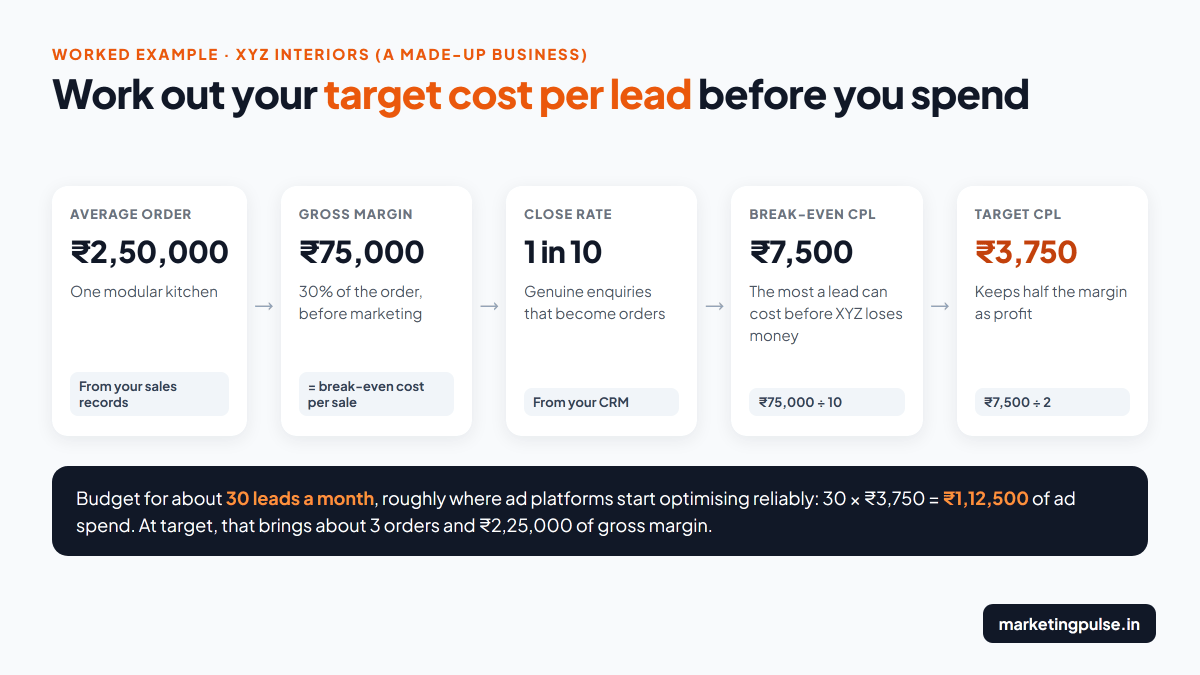
That gives a break-even cost per lead of ₹7,500. XYZ wants to keep at least half its margin as profit, so its target is ₹3,750 a lead. Our working rule, published on our pricing page, is an ad budget big enough for roughly 30 conversions a month, because that is about where the ad platforms start optimising reliably. At ₹3,750 a lead, that means ₹1,12,500 a month in ad spend.
| If XYZ Interiors hits its target for a month | Amount |
|---|---|
| Ad spend (30 leads at ₹3,750) | ₹1,12,500 |
| Agency fee (our Growth plan, Google and Meta) | ₹26,000 |
| Orders (1 in 10 leads) | 3 |
| Revenue from those orders | ₹7,50,000 |
| Gross margin from those orders | ₹2,25,000 |
| Left after ad spend and fee, before GST | ₹86,500 |
| Return on ad spend (revenue ÷ ad spend) | 6.7x |
Return on ad spend (ROAS) is revenue divided by ad spend. XYZ's break-even ROAS is 1 ÷ 30%, about 3.3x, so 6.7x leaves room for a bad month. GST adds 18% to the agency fee and to the ad spend Google bills in India (Google Payments Help), and a GST-registered business can usually claim it back as input tax credit.
The second example is about lead quality. Say XYZ Coaching, another made-up business, runs two Meta campaigns with ₹30,000 each for a month:
| Campaign A: instant lead form | Campaign B: click-to-WhatsApp | |
|---|---|---|
| Leads | 200 | 100 |
| Cost per lead | ₹150 | ₹300 |
| Leads the counsellors could qualify | 20 | 40 |
| Cost per qualified lead | ₹1,500 | ₹750 |
Judged on cost per lead, Campaign A wins easily. Judged on what the counsellors could use, Campaign B costs half as much. The numbers are invented, but the pattern is the reason strategy 5 matters: if the platform only hears about form fills, it will keep buying more of Campaign A's leads.
The numbers to track
| Metric | How to work it out | What it tells you |
|---|---|---|
| Click-through rate (CTR) | Clicks ÷ impressions | Whether the ad interests the people seeing it |
| Cost per click (CPC) | Ad spend ÷ clicks | What the auction charges you for a visitor |
| Conversion rate | Conversions ÷ clicks | Whether the landing page and offer persuade |
| Cost per lead (CPL) | Ad spend ÷ leads | The headline number in most lead campaigns |
| Cost per qualified lead | Ad spend ÷ leads your team accepted | The number that matches your sales team's experience |
| Customer acquisition cost (CAC) | (Ad spend + fees) ÷ new customers | What a customer really cost you |
| Return on ad spend (ROAS) | Revenue from ads ÷ ad spend | The main efficiency measure for online stores |
| Break-even ROAS | 1 ÷ gross margin | The ROAS below which every sale loses money |
| Marketing efficiency ratio (MER) | Total revenue ÷ total marketing spend | A check on platform reports, because it cannot count a sale twice |
| Customer lifetime value (LTV) | Average profit per customer over the whole relationship | How much you can afford to pay to win a customer |
If you can watch only one number each month, make it cost per customer or per qualified lead from your own records. Each platform counts conversions by its own rules, so a buyer who saw both a Google ad and an Instagram ad can be claimed by both, and adding up their reports can overstate what the ads did.
Tools a performance marketing team uses
- Google Ads, Meta Ads Manager and LinkedIn Campaign Manager run the ads, and marketplaces such as Amazon and Flipkart have ad consoles of their own.
- Google Analytics 4, Google Tag Manager, the Meta Pixel with the Conversions API, and call-tracking numbers record what happens after the click.
- Looker Studio dashboards, or a shared sheet linked to your CRM, turn that data into a monthly report.
- Microsoft Clarity, which is free, shows recordings and heatmaps of real visits to your landing page, and PageSpeed Insights checks how fast it loads.
- Google Keyword Planner shows search demand, and the Meta Ad Library and Google Ads Transparency Centre show the live ads of any advertiser, including your competitors.
- A CRM can be anything from a Google Sheet to Zoho or LeadSquared, as long as every lead gets a status your agency can see.
AI now runs most of the bidding. What does the agency do?
Two changes in 2025 and 2026 moved the job. Google is moving Search campaigns to AI Max, which lets its AI match ads to more searches and write ad text from your website. Campaigns that use automatically created assets or campaign-level broad match began upgrading automatically from September 2026, and Dynamic Search Ads follow from February 2027 (Google). Google says campaigns using the full AI Max feature set see an average of 7% more conversions or conversion value, at a similar cost per result, than campaigns using only its expanded search matching, based on Google's own data. Meta's Advantage+ campaigns already pick audiences, placements and budgets automatically, and Meta says they deliver a 20% lower cost per result on average.
Treat both figures as the platforms' own claims. They may hold on average and still be wrong for your account, which makes strategy 1 more important now than it was. With bidding and targeting automated, the human work moves to what the machines depend on: accurate conversion data, the offer, the ads themselves, the landing page, controls such as brand and negative keywords, and the decision to stop a campaign the platform would happily keep spending on. That also answers whether performance marketing has a future: the buying is increasingly automatic, while those decisions still need someone who knows your business.
Privacy and ad rules in India
India's Digital Personal Data Protection Rules, 2025 were notified on 14 November 2025 and take effect in stages. Most obligations on businesses, including the rules on privacy notices, apply 18 months after notification, which is May 2027. Performance marketing runs on personal data (phone numbers in lead forms, customer lists uploaded for targeting, data collected by tracking tags), so it is worth getting ready early. Sensible steps include a clear consent line on every lead form, a privacy notice that says how lead data is used, and deleting lead data you no longer need. Take legal advice on the details for your business.
Some sectors have extra rules. Google gives healthcare and medicine ads additional checks under its healthcare policy, and ads for registered real estate projects must show the RERA registration number under Section 11(2) of the Real Estate Act.
When performance marketing is the wrong choice
Performance marketing is a poor fit, at least for now, in these situations:
- Your budget cannot buy about 30 conversions a month. Below that, the platforms learn slowly and a fixed management fee takes a big share of the money. Start with SEO and your Google Business Profile; our digital marketing cost guide shows how much of a small budget fees take.
- You cannot track the result. If sales happen offline and nobody records where each customer came from, the ads will be judged on guesses. Fix tracking first.
- Your offer is weaker than the competition's. Ads put an offer in front of people faster, so a price or product that compares badly loses faster too.
- Nobody searches for what you sell yet. Search ads can only capture demand that exists, so a new kind of product needs awareness first, through video, social media or PR.
- You win a handful of very large deals a year. Bidding systems need volume to learn, so a few enterprise sales a year are often better served by direct outreach and tightly targeted LinkedIn campaigns.
What the first 90 days with an agency should look like
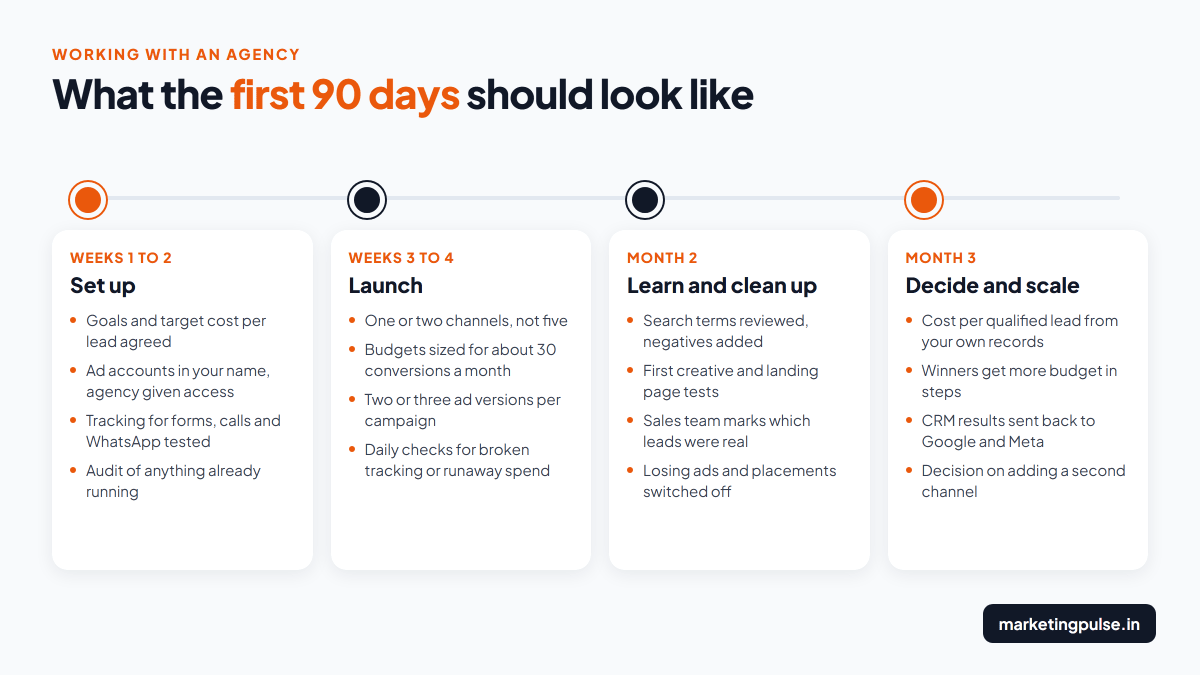
The first month often costs more per lead than later months, because the platforms are still learning and the first tests have not finished. By the end of month three you should have a cost per qualified lead from your own records and a clear decision about what to scale. Raise budgets on winning campaigns in modest steps so the bidding systems have time to adjust.
What performance marketing services cost in India
You pay for three things: the agency's fee, the ad budget (paid straight to Google, Meta or the marketplace from your own account) and 18% GST on both. Our fees are published. Ads management starts at ₹16,000 a month for one platform with up to ₹1,00,000 of monthly ad spend, ₹26,000 for Google and Meta together with up to ₹5,00,000, and ₹52,500 for larger accounts that need every platform, server-side tracking and a creative production roadmap. Every plan is on our pricing page, and the service details are on our Google Ads and Meta ads pages.
To see how the rest of the market prices this, on 4 October 2026 we read five Indian agency pricing guides from the first page of Google for "performance marketing agency pricing plans per month india". Starting retainers began at ₹15,000 a month. Agencies charging a share of ad spend quoted 10% to 20%, falling to between 8% and 12% at larger budgets, and percentage deals usually came with a minimum monthly fee. One guide noted that purely performance-based contracts are uncommon among established agencies.
A minimum fee changes the arithmetic at small budgets. Here is the share of ad spend that goes to the agency under three common models, using simple examples:
| Monthly ad spend | Flat fee of ₹26,000 | 15% of spend | 15% with a ₹50,000 minimum |
|---|---|---|---|
| ₹1,00,000 | 26% | 15% | 50% |
| ₹3,00,000 | 8.7% | 15% | 16.7% |
| ₹5,00,000 | 5.2% | 15% | 15% |
Flat fees work out cheaper as budgets grow, and percentages work out cheaper at small budgets until a minimum fee applies. Whatever the model, check that the ad budget goes from your account to the platform with no mark-up, and that the ad accounts are registered in your name.
How to choose a performance marketing agency
Many "top agencies in India" lists are published by agencies, sometimes with themselves near the top. These questions will tell you more in a single call:
| Ask | A good answer | A warning sign |
|---|---|---|
| Who owns the ad accounts? | You do, and the agency gets partner or manager access | The account belongs to the agency, so you lose its history if you leave |
| How do you charge, and do you mark up ad spend? | A stated fee, with ad spend billed by the platform to you | Ad spend routed through the agency with no invoice from Google or Meta |
| What will you track before launch? | Named conversions, including calls and WhatsApp, tested before ads go live | "We will set that up once the campaigns are running" |
| Which number will you report on? | Cost per qualified lead or per sale, checked against your CRM | Impressions, reach and clicks as the headline results |
| How will we know the ads caused the sales? | Brand or regional pause tests, platform lift tests and total-revenue checks | Only the ROAS the platform reports |
| What happens in the first 90 days? | A written plan like the one above | Guaranteed rankings, lead counts or ROAS before anyone has seen your account |
| What is the notice period? | Monthly, or a short first term | A long lock-in with penalties for leaving |
If an agency answers most of these well, a slightly higher fee is usually money well spent. If it cannot answer the first two clearly, keep looking.
Frequently asked questions
What are performance marketing services?
They are the work of planning, running and measuring paid advertising against a result you can count, such as a lead or a sale. A full service covers tracking, campaign management on platforms like Google and Meta, ad creative, landing page improvements and reporting tied to your own sales records.
What does a performance marketing agency do every month?
It reviews search terms and placements, moves budget from losing campaigns to winning ones, tests new ads and landing pages, checks that tracking still works, and reports cost per lead or per sale. Most of this happens weekly or fortnightly, with a full report and plan once a month.
What are examples of performance marketing?
A Google Search ad for "packers and movers near me" charged per click, an Instagram ad that opens a WhatsApp chat, a sponsored product listing on Amazon, a YouTube ad aimed at app installs, and an affiliate website earning a commission on each sale it sends you.
Is performance marketing the same as digital marketing?
No. Digital marketing covers everything done online, including SEO, organic social media and email. Performance marketing is the paid part that is tracked to specific actions such as leads and sales.
Which is better, SEO or performance marketing?
They do different jobs. Ads bring enquiries within days and stop when you stop paying, while SEO takes months and keeps working. Many businesses use ads for leads now and SEO to bring their cost per lead down over time.
How much does performance marketing cost in India?
Published agency retainers start at about ₹15,000 a month, plus your ad budget and 18% GST. At MarketingPulse, ads management starts at ₹16,000 a month for one platform. Agencies that charge a share of spend usually quote 10% to 20% of it, often with a minimum fee. All our prices are on the pricing page.
How much ad budget do I need to start?
Enough for about 30 conversions a month. Multiply your expected cost per lead by 30: at ₹500 a lead that is ₹15,000 a month, and at ₹3,000 a lead it is ₹90,000. Most of our ads clients start with ₹50,000 to ₹1,00,000 a month.
How long does performance marketing take to work?
Ads can bring enquiries in the first week, but give a new account about 90 days before you judge it. The first month goes on learning and fixing tracking, and months two and three show whether the cost per lead is heading towards your target.
Is performance marketing worth it?
It is when the numbers work: your target cost per lead or sale sits comfortably below what a customer is worth, you can track results, and your budget can fund about 30 conversions a month. If any of those is missing, fix it first or start with SEO.
What is the 70/20/10 rule in digital marketing?
A budgeting rule: about 70% of spend on what already works, 20% on improving it and 10% on new experiments. Coca-Cola made it well known for content planning, and it suits ad budgets because it protects the campaigns that pay the bills while leaving room to find the next one.
Does performance marketing have a future with AI?
Yes, though the job is changing. Google's AI Max and Meta's Advantage+ now automate much of the bidding and targeting, so the human work moves to conversion data, offers, creative, landing pages and checking whether the results the platforms report are real.
Can an agency work only on commission or guarantee results?
On Google and Meta you pay for clicks or impressions whatever happens, so an agency that guarantees leads or works only on commission is carrying that cost and pricing it in. Ask for the expected cost per lead in your own ad account instead, and treat guaranteed numbers offered before an audit as a warning sign.
Is SEO dead now that AI answers questions?
No. Google's AI Overviews and tools like ChatGPT still draw on web pages, so being the page they cite has become part of SEO. Our guide to AEO, SEO and GEO explains how they fit together.
The short version
Performance marketing services are paid advertising run against a number you can check, usually cost per lead, cost per sale or return on ad spend. A complete service includes tracking, campaign management, the ads, landing pages, optimisation and reporting tied to your own records. On Google and Meta you still pay for clicks and impressions, so the agency earns its fee by turning them into customers at a cost below what each customer is worth to you.
The public evidence from eBay, Uber, Airbnb, P&G and Booking.com points the same way: measure what the ads add, check who claims the credit, keep some budget for brand, test steadily, and feed real sales back to the platforms. To see how that would look for your business, send us your website and we will reply within one working day with a plan, the ad budget it needs and our fee.
Is performance marketing right for your business?
Send us your website and monthly budget. Within one working day we will reply with the channels we would start with, the ad budget they need and our fee, GST included. No obligation.

Written by
Heeresh Varshney
Founder & MD, MarketingPulse · 10+ years in digital marketing
First-generation entrepreneur with proven digital marketing strategies and a long list of happy clients. Heeresh loves using advanced technology as a solution for business growth — and can help you hit your business targets with digital marketing that is measured, not guessed. More about Heeresh.