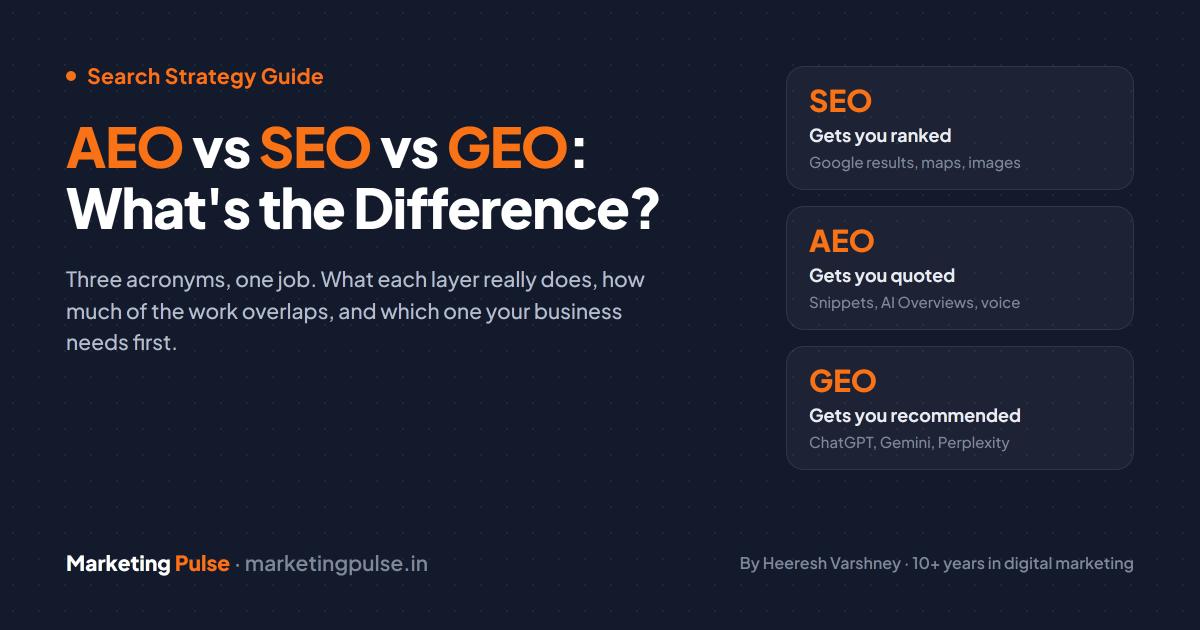
SEO, AEO and GEO are three layers of the same job: getting found. SEO earns a position in search results that people click. AEO gets your answer lifted into a featured snippet, a People Also Ask box or a Google AI Overview. GEO gets your brand named inside answers that ChatGPT, Gemini, Perplexity and Copilot write from scratch. Almost every business needs all three, and most of the underlying work is the same work.
I have spent ten years doing search work for Indian businesses, from dental clinics in Dwarka to steel dealers in Raipur, and in the last two years I have watched the same conversation happen in almost every sales call. Someone has read that SEO is dead, that AEO is the replacement, that GEO is the replacement for the replacement, and that there is a new package they need to buy. Usually there isn't.
This guide gives you the honest version. What each acronym actually means, how much of the work overlaps, what the published data says (including where the studies flatly contradict each other), what Google itself says about optimising for AI, a way to decide which layer deserves your budget first, and a thirty-day plan you can start on Monday.
The short answer, in one table
| Compared on | SEO | AEO | GEO |
|---|---|---|---|
| Stands for | Search engine optimisation | Answer engine optimisation | Generative engine optimisation |
| The question it answers | Can I rank for this search? | Can my answer be lifted out of my page? | Will an AI name my brand when someone asks? |
| Where you show up | Google and Bing results, maps, images | Featured snippets, People Also Ask, AI Overviews, voice assistants | ChatGPT, Gemini, Perplexity, Copilot, AI Mode |
| What you change | Site structure, page content, speed, links | Answer format, headings, schema, FAQ blocks | Authority, citations, mentions across other sites |
| What you measure | Rankings, clicks, conversions | Snippet share, AI Overview appearances | Mention rate across AI prompts, referral visits |
| Who clicks | Most of the traffic | A minority, by design | A small but high-intent minority |
| How long it takes | Three to six months | Weeks, once you rank | Months, and it moves slowly |
What SEO is now, not what it was in 2018
SEO is the work of making a website that Google can crawl, understand, trust and rank. That definition has not changed. What has changed is that the finish line moved. Ten years ago you optimised for a list of ten blue links. Today the same page has to survive an AI Overview at the top, a map pack, a People Also Ask block and a shopping row before anyone reaches position one.
The underlying work is unglamorous and unchanged: pages that load fast on a mid-range Android phone, a site structure a crawler can follow, titles that match how people actually search, content that answers the question better than the pages already ranking, and enough trust signals for Google to prefer you in a close contest. That is what our SEO services do, and it is the layer everything else sits on.
Here is the part that decides most of this article: AI answers draw on pages that are already indexed and ranking somewhere. In a March 2026 Ahrefs study of 863,000 keywords, 38% of the pages cited in AI Overviews ranked in the top ten for that query, and roughly seven in ten ranked somewhere in the top hundred. A page Google has not indexed, or does not trust, is not a candidate for the snippet, the AI Overview or the AI citation. Skipping SEO to do AEO is like skipping the foundation to install the roof.
What AEO is
Answer engine optimisation, or answer engine optimization if you spell it the American way, is the practice of writing and marking up your page so a machine can lift a clean, correct answer straight out of it.
That machine might be Google building a featured snippet, Google generating an AI Overview, Alexa reading a result aloud, or Bing Copilot summarising. The formats differ; the requirement is the same. The answer has to be findable inside your page without the machine having to interpret you.
In practice AEO is four habits:
- Ask the question in the heading, in the words a person would use, then answer it in the first forty to sixty words underneath. No preamble.
- Give one idea per paragraph so a paragraph can stand alone when it is extracted.
- Use tables and short lists for anything comparative, because comparisons are what get pulled.
- Add FAQ blocks with real questions from sales calls, not invented ones.
The trade-off is honest and worth stating: AEO often wins you the answer and loses you the click. Someone reads your definition in the AI Overview and never visits. You get the brand impression, not the session. For businesses selling something considered, that impression still pays. For businesses whose whole model is ad-supported pageviews, it hurts.
What GEO is
Generative engine optimisation is the practice of making an AI assistant name your business when someone asks it a question you would want to be the answer to.
The mechanics are different from SEO in one way that matters. SEO is mostly a first-party game: you control your website, so you can fix it. GEO is mostly a third-party game. When ChatGPT decides which packers and movers in Raipur to name, it is drawing on what other sources say about you, not on your homepage copy. Your Google Business Profile, your reviews, directory listings, a Reddit thread, a YouTube video, a news mention, a comparison article on someone else's blog.
Which means GEO work looks like this:
- Being present and consistent everywhere your category is discussed, starting with a complete Google Business Profile and accurate listings.
- Earning mentions on sites the models already trust, which is digital PR by another name.
- Publishing content with real statistics, named sources and quotable sentences, because that is what gets picked up.
- Making sure your name, address and services are stated identically everywhere, so the model is not reconciling three versions of you.
That third point is not a guess. The Princeton and IIT Delhi research paper that named GEO (Aggarwal et al., published at KDD 2024) tested nine content changes against a benchmark of real queries. Adding citations, quotations and statistics produced the largest gains, improving visibility in generated answers by up to 40% on their position-adjusted word count metric. Keyword stuffing made pages slightly less visible than leaving them alone. If you want the full picture of how assistants pick their sources, which AI crawlers to allow and a ninety-day plan, my beginner's guide to GEO covers it step by step, and our GEO services page shows how we do it for clients.
AIO, LLMO, SXO, AAO: do you need to learn these too?
No. You will meet AIO (AI optimisation), LLMO (large language model optimisation), SXO (search experience optimisation) and AAO (AI agent optimisation). Every few months someone coins another one, usually while selling a package that goes with it.
AIO and LLMO are GEO with different labels. SXO is SEO plus conversion rate work, which good agencies have always done. AAO is the only one pointing at something genuinely new: AI agents that book, buy and fill forms on a user's behalf, which will eventually make your booking flow and your structured business data matter in ways they do not today. It is worth watching. It is not worth a line in your budget yet.
Three acronyms describe the whole field right now. If someone quotes you for a fourth, ask which of the three it replaces.
How much of this is actually different work?
This is the question nobody selling an AEO retainer wants asked, so here is the answer laid out task by task. These are the twelve jobs that a search programme actually consists of, and which layer each one serves.
| The job | SEO | AEO | GEO |
|---|---|---|---|
| Fast, crawlable, indexable pages | Yes | Yes | Yes |
| Content that answers a real question properly | Yes | Yes | Yes |
| Question-shaped headings with the answer directly under them | Yes | Yes | Yes |
| A named author with verifiable credentials | Yes | Yes | Yes |
| Original statistics, sources and quotable lines | Yes | Yes | Yes |
| Complete Google Business Profile and reviews | Yes | Yes | Yes |
| Identical business details across every directory | Yes | Yes | Yes |
| Schema markup for organisation, FAQ, product, local business | Yes | Yes | No |
| A 40 to 60 word answer at the top of each section | No | Yes | Yes |
| Links and mentions from sites in your industry | Yes | No | Yes |
| Keyword research, titles and meta descriptions | Yes | No | No |
| Allowing AI crawlers through robots.txt | No | No | Yes |
- Serve all three (SEO + AEO + GEO)7 tasks
- Serve two of the three3 tasks
- Serve one layer only2 tasks
Counted from the table above. Only keyword research and the AI crawler check belong to a single layer; everything else is shared work.
Ten of twelve jobs do double or triple duty. The one genuinely GEO-only task, checking that your robots.txt lets AI crawlers through, takes about ten minutes.
So when someone quotes you a separate monthly fee for AEO and another for GEO, ask them which of these twelve lines they are doing that your SEO retainer does not already cover. It is a fair question and a good agency will answer it in a sentence.
What the data says, and why the numbers disagree so badly
Search "AI Overview statistics" and you will be handed confident percentages that contradict each other. Understanding why is more useful than picking one.
- Semrush, 10M keywords (Nov 2025)15.7%
- Semrush, mid-year peak (Jul 2025)24.6%
- BrightEdge, 9 commercial industries48%
- BrightEdge, healthcare queries only88%
Semrush tracked over 10 million keywords through 2025; BrightEdge tracks nine commercial industries. Neither is wrong. They measure different query panels, which is exactly why one number cannot be quoted as the number.
The spread is not a scandal. Semrush's panel leans towards short keyword-research style queries. BrightEdge tracks longer, more informational commercial queries, where AI Overviews are far more common. Your own figure depends entirely on the questions your customers ask. Healthcare and education businesses are living in the 80% world. A shop selling a branded product by name is closer to the 5% world, because branded searches rarely trigger an AI Overview at all.
What an AI Overview does to your clicks is better documented. Amsive analysed 700,000 keywords across ten websites in five industries:
| Situation | Change in click-through rate |
|---|---|
| Any keyword that triggers an AI Overview | Down 15.49% on average |
| Non-branded keywords | Down 19.98% |
| Keywords where you rank outside the top three | Down 27.04% |
| Keywords with both an AI Overview and a featured snippet | Down 37.04% |
| Branded keywords that trigger an AI Overview | Up 18.68% |
Two things fall out of that table. Ranking outside the top three is now much more expensive than it used to be, because an AI Overview absorbs the attention that used to trickle down to positions four through ten. And a strong brand is a hedge, because branded searches both trigger AI Overviews rarely and perform better when they do. Building a name people search for is a search tactic now.
Does AI traffic actually convert better?
You will see this claimed constantly, usually as a single confident multiple. The published studies do not agree.
- Seer Interactive9 ×
- Semrush (500+ topics)4.4 ×
- Visibility Labs (94 ecommerce brands)1.3 ×
Seer Interactive measured 15.9% against 1.76% for Google organic. Semrush studied 500+ high-value topics. Visibility Labs measured 94 ecommerce brands at 1.81% against 1.39% for non-branded organic. Same claim, three very different answers.
The honest reading is that AI referral traffic tends to convert better than average organic traffic, by somewhere between a little and a lot depending on who is measuring and what they sell. The mechanism is intuitive: someone who has already had a conversation with an assistant, described their problem and been given three names arrives further along than someone who typed two words into Google.
The volume caveat matters just as much. For most sites, AI assistants still send around 1% or less of total visits. Semrush found ChatGPT's referral volume to other websites grew 206% year over year between January 2025 and January 2026, so the direction is clear, but 206% growth on a very small number is still a small number. Plan for where it is going, and pay the bills with where it is now.
The prediction everyone quotes, and what actually happened
In February 2024, Gartner predicted that traditional search engine volume would fall 25% by 2026 as AI chatbots absorbed the queries. That line has been quoted in almost every article on this topic for two years, usually as the reason you need to buy something.
It is now late 2026, so we can check. Google was handling roughly 16.4 billion searches a day in early 2026 and holds close to 90% of global search share by StatCounter's measure. Total search volume has not fallen 25%. What has happened instead is that search got a second front: the same person now asks Google and asks an assistant, often about the same purchase, and expects to find you in both places.
That is a better story for a business owner than the collapse narrative, because it means nothing you already built has been wasted. It also means the work has genuinely widened, which is the part the "SEO is dead" crowd gets backwards.
What Google itself says about optimising for AI
This is the single most useful source in this entire article, and it is free. Google publishes an official guide to AI features and your website, and it is unusually blunt about the tactics being sold as AEO and GEO.
In Google's own words, you do not need to create new machine-readable files, AI text files, markup or Markdown to appear in Google Search. There is no requirement to break your content into small pieces for AI to understand it. You do not need to write in a specific way just for generative AI search. Structured data is not required for generative AI search, and there is no special schema.org markup you need to add.
Google then adds a warning worth taping to your monitor: be wary of third-party tools that promise ranking success or claim to use internal Google metrics.
What Google says does matter is the ordinary list. Genuinely useful content with a point of view of its own. Pages that are crawlable, indexable and technically sound. A good experience on the device people actually use. Clean, semantic HTML. No duplicate content. Performance you actually monitor in Search Console.
Two caveats before you throw away your schema. First, this guidance covers Google's AI features only. ChatGPT, Perplexity and Copilot publish nothing equivalent, and structured data plausibly helps them parse you. Second, schema still earns rich results in ordinary search, which is reason enough to keep it. Google is saying schema is not a magic AI ingredient, not that schema is useless.
So which one do you actually need?
Three questions settle it for most businesses.
Do you rank on page one for the searches that bring you money? If not, start there. AEO and GEO both draw mostly on pages that are indexed and ranking, so polishing answer formats on a page Google does not show for anything related gives them nothing to work with.
Do the searches your customers use trigger AI Overviews? Type ten of your real money keywords into Google on a phone and count. If eight of ten show an AI Overview, AEO stops being optional. If one of ten does, you have time.
Would a stranger asking an AI assistant about your category ever reach you? Ask ChatGPT for the best provider of what you sell in your city. If your competitors are named and you are not, GEO is where the gap is.
| If you are… | Start with | Then add | Because |
|---|---|---|---|
| A local service business (clinic, movers, salon, coaching) | SEO plus Google Business Profile | AEO | The map pack still decides who gets the call, and assistants read your profile and reviews to answer "near me" questions |
| A new site with little content | SEO only | Nothing yet | You cannot be quoted from pages that are not indexed |
| An established site ranking well but losing traffic | AEO | GEO | Your rankings are intact and an AI Overview is eating the clicks; own the answer instead |
| B2B or a considered, high-value purchase | GEO alongside SEO | AEO | Buyers research with assistants for weeks; being one of three names recommended is worth more than a click |
| Ecommerce | SEO and product schema | AEO | Product data quality drives both shopping surfaces and AI product answers |
| A brand people already search by name | SEO plus reputation work | GEO | Branded queries are your best-performing traffic; protect what an assistant says about the name |
| A publisher or content site | AEO defensively | GEO | Zero-click answers hit you hardest, so shift value into things a summary cannot replace |
If you are choosing where a limited budget goes across channels more broadly, the 3-3-3 rule is the framework I hand most clients, and the seven types of digital marketing guide sets out what each channel costs and how long it takes.
A thirty-day plan that covers all three
Nothing here needs new software or a new retainer. Most of it is one person, a few hours a week.
Week one, foundations. Pull your top twenty pages by traffic and revenue from Search Console. Check each one loads in under three seconds on mobile, has one clear H1, and has headings a stranger could scan. Fix the slow ones first, since page speed is the one item on this list that affects every layer at once and is the most common thing our web development work has to repair.
Week two, answers. Take those same twenty pages. Under each H2, put a forty to sixty word answer to the question that heading implies, in plain words, before any build-up. Add a FAQ section of five real questions from your sales calls. Add FAQ and Organization schema if it is not already there.
Week three, entity. Complete your Google Business Profile properly: categories, services, hours, photos, and a plan for asking for reviews. Then find every directory that lists you and make the name, address, phone and category identical. Search your own brand name and see what the first page says about you, because that page is what an assistant reads.
Week four, measure and mention. Record a baseline: rankings for twenty keywords, AI Overview presence for those same keywords, and the answers four assistants give to ten prompts about your category. Then pick one thing worth a mention, a piece of original data, a local sponsorship, a genuinely useful tool, and pitch it to three places your industry reads.
Repeat weeks two through four every quarter, and if you need enquiries while the slow layers build, run Google Ads on your buying-intent keywords in parallel rather than waiting. Our guide to performance marketing services covers how to judge those ads by the enquiries they bring.
How to check whether AI already mentions you, in twenty minutes
Do this yourself before you pay anyone to do it. Open ChatGPT, Gemini, Perplexity and Google's AI Mode, and run the same prompts in each, logged out where you can:
- "Best [your service] in [your city]"
- "Who should I hire for [your service] in [your city]?"
- "Compare the top [your service] providers in [your city]"
- "Is [your business name] any good?"
- "What does [your business name] do?"
Note four things per prompt: whether you appear, who does appear, which websites are cited underneath, and whether anything said about you is wrong. That last one is often the most useful, because assistants can repeat an old phone number or address from a directory listing nobody has updated in years.
The websites cited underneath are your actual GEO to-do list. Those are the pages the model trusts on this topic. Getting your business accurately represented on those specific pages will move you faster than any amount of rewriting your own homepage.
What to measure, and where to find it
| Layer | The number that matters | Where you get it | Realistic cadence |
|---|---|---|---|
| SEO | Clicks and average position for money keywords | Google Search Console | Weekly |
| SEO | Enquiries attributed to organic | GA4 plus your call log | Monthly |
| AEO | Share of tracked keywords where you hold the snippet or appear in the AI Overview | Manual check or a rank tracker with AI Overview tracking | Monthly |
| AEO | Impressions rising while clicks stay flat | Search Console, comparing the two lines | Monthly |
| GEO | Mention rate across a fixed set of prompts | Run the prompts yourself and log the results | Monthly |
| GEO | Referral sessions from chatgpt.com, perplexity.ai, gemini.google.com | GA4 referral report | Monthly |
| All three | Branded search volume | Search Console, queries containing your name | Quarterly |
The last row is the one most people skip and the one I would keep if I could only keep one. Rising branded search means the other three layers are working, whether or not you can attribute the individual visit. When someone hears about you in an AI answer and then Googles your name to check you are real, branded search is where that shows up.
Where local businesses actually win
Most of the writing on this topic assumes you are a SaaS company competing globally. If you run a clinic in Dwarka or a logistics firm in Raipur, the picture is simpler and the odds are better.
For "near me" and city-level questions, assistants lean heavily on the same data Google's map pack uses: your Business Profile, your reviews, and consistent listings across directories. That is the same work that wins the map pack, which means local SEO and GEO are close to the same project for a local business. A clinic with a complete profile, ninety genuine reviews and consistent citations is a strong candidate to be named by an assistant, and it did not have to do anything AI-specific to get there.
Local competition is also thinner. Very few businesses in Aligarh, Chandigarh or Raipur have checked what an assistant says about their category, so a listing that is merely complete and consistent, like the ones we build on our Raipur GMB projects, is often enough to be the one that gets named.
Common mistakes I keep seeing
- Buying a GEO retainer while the website fails Core Web Vitals. Fix what is broken before optimising for what is new.
- Rewriting every page in a stiff, robotic style "for the AI". Google says explicitly that you do not need to write differently for generative search, and stripped-down copy converts worse for the humans who do arrive.
- Chasing AI Overviews for bottom-of-funnel keywords. "Book an appointment" queries rarely trigger them. Informational questions do. Point your AEO effort where AI Overviews actually appear.
- Treating a zero-click answer as a failure. If your name is in the answer, you got the impression. Judge the layer by branded search and enquiries, not by sessions.
- Publishing thirty thin FAQ pages to "capture answers". Depth wins in every layer, which is why a real content marketing plan produces one properly researched page instead of ten shallow ones.
- Blocking AI crawlers by accident. Check robots.txt for OAI-SearchBot and PerplexityBot before you conclude that GEO is not working.
Frequently asked questions
Is SEO dead because of AI?
No. Google was still handling roughly 16.4 billion searches a day in early 2026 with close to 90% global share, and most pages cited in Google's AI Overviews still rank somewhere in its top hundred. What has died is the assumption that a top-three ranking automatically delivers the click it used to.
What is the difference between AEO and GEO?
AEO gets your answer extracted and displayed, usually inside a search result such as a featured snippet or an AI Overview. GEO gets your brand cited inside an answer an AI writes from scratch in ChatGPT, Gemini, Perplexity or Copilot. AEO is mostly about how your page is written; GEO is mostly about what the rest of the internet says about you.
Do I need to hire a separate AEO or GEO agency?
Almost certainly not. On a twelve-item search checklist, ten items serve more than one layer, so a competent SEO team is already doing most of the work. Before paying a separate fee, ask exactly which tasks it covers that your current retainer does not.
Does schema markup help me appear in AI Overviews?
Google states plainly that structured data is not required for its generative AI features and that there is no special schema.org markup to add. Keep schema anyway: it earns rich results in ordinary search, and other AI systems that publish no guidance may still use it to parse your pages.
How long does GEO take to show results?
Longer than SEO, in my experience, because you are waiting on other websites to mention you and on models to be retrained or re-crawled. Treat it as a two-quarter project, measure it monthly with a fixed set of prompts, and expect movement in mentions before you see any referral traffic.
Is GEO worth it if AI sends only 1% of my traffic?
It depends on your sales cycle. For an impulse purchase, 1% is 1%. For a considered purchase where buyers research for weeks, being one of three names an assistant recommends shapes the shortlist long before anyone visits your site, and that influence does not show up in your referral report.
What is the fastest AEO win for a small business?
Take your five highest-value pages and put a direct forty to sixty word answer immediately under each heading, then add a FAQ section built from questions customers actually ask on the phone. It is a few hours of work on pages that already rank, and it is the highest-return change on this list.
Should I block AI crawlers to protect my content?
Only if you sell access to the content itself. If you sell a product or a service, blocking OAI-SearchBot or PerplexityBot removes you from answers your competitors will appear in. Note that GPTBot and OAI-SearchBot do different jobs, so check which one you are blocking before you decide.
Does AEO work for voice search too?
Yes, and it is the same work. Voice assistants read out a single extracted answer, so the format that wins a featured snippet, a direct answer in plain words near the top of the page, is the format that wins a voice result.
Which should a business with a small budget do first?
SEO, without hesitation. AEO and GEO both compound off pages that already rank and a business that is already described consistently online. If your site is slow, thin or unindexed, every rupee spent on the other two layers is being spent on a page nothing will ever quote.
The short version
SEO gets you ranked. AEO gets you quoted. GEO gets you recommended. They are three views of one job, and ten of the twelve tasks that make up that job serve more than one of them.
Get the site fast and indexed, answer real questions directly near the top of every section, keep your business details identical everywhere, earn mentions on the sites your buyers already read, and measure branded search alongside your rankings. Do that and you are running all three layers whether or not anyone puts a new acronym on the invoice.
If you want to know where you actually stand, we will check your rankings, your AI Overview presence and what four assistants say about your business, and tell you which of the three layers is the weak one. You can see what we charge and what our GEO service includes before you ask, and what we have done for other clients while you decide.
Where do you stand across all three?
Send us your website. We will check your rankings, whether you appear in AI Overviews, and what four AI assistants say about your business, then tell you which layer is the weak one.

Written by
Heeresh Varshney
Founder & MD, MarketingPulse · 10+ years in digital marketing
First-generation entrepreneur with proven digital marketing strategies and a long list of happy clients. Heeresh loves using advanced technology as a solution for business growth — and can help you hit your business targets with digital marketing that is measured, not guessed. More about Heeresh.