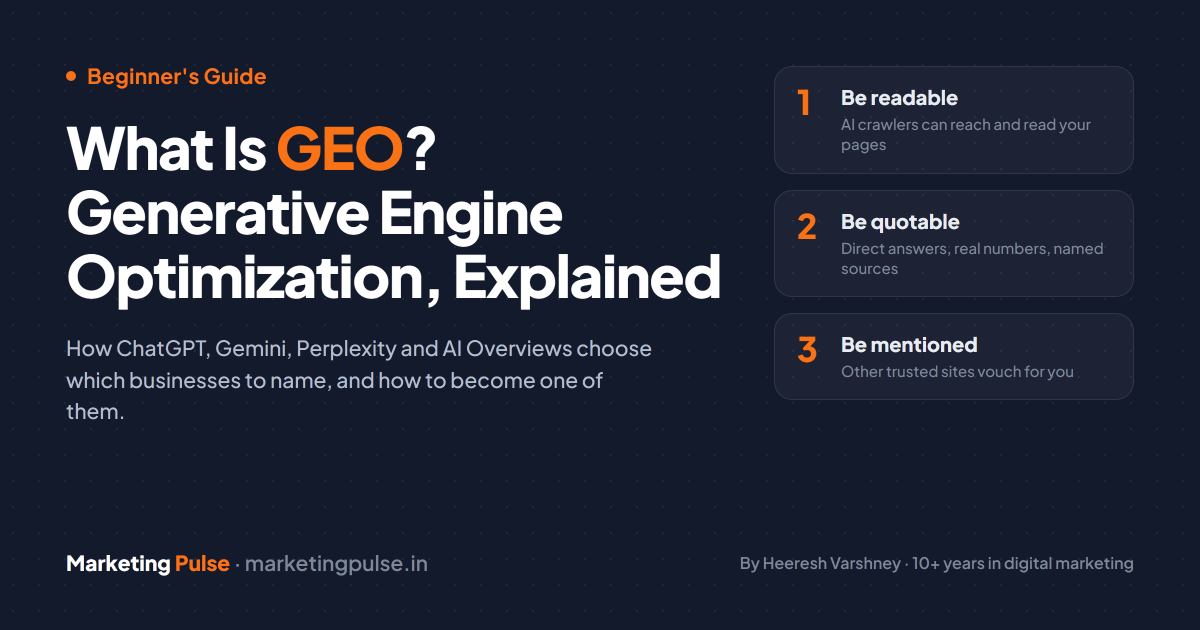
GEO, or generative engine optimization, is the practice of making your business the one AI assistants mention, recommend and link to when they answer a question. It covers ChatGPT, Google's AI Overviews and AI Mode, Gemini, Perplexity, Claude and Copilot. Where SEO gets you into a list of results, GEO gets you into the answer.
I have done search marketing for ten years, and GEO is the first change in that time that made me rethink where the work happens. With SEO, most of the work happens on your own website. With GEO, most of it happens on other people's sites: review sites, directories, YouTube, LinkedIn, forums, and the articles that compare you with your competitors. I think that is the most useful thing for a beginner to grasp, and most GEO guides bury it under tool recommendations.
This guide assumes you are starting from zero. It explains where the term came from, how an assistant decides what to cite and why each one behaves differently, then goes through what the published research says works (and what makes things worse) and which AI crawlers to let in. It ends with a free audit you can run this afternoon, a ninety-day plan and a glossary of every term used here.
GEO in one paragraph
For a side-by-side comparison with SEO and AEO, see AEO vs SEO vs GEO. This article stays with GEO and goes further into it.
Where the term came from (and what it is not)
In November 2023, researchers from IIT Delhi, Princeton University and independent labs published a paper called GEO: Generative Engine Optimization, later presented at KDD 2024, one of the main academic conferences for data science. They built a benchmark of 10,000 real search queries and tested which changes to a web page made AI-generated answers use it more. The marketing industry borrowed their acronym, and it stuck.
GEO in this sense has nothing to do with geography. If you arrived here looking for geo-targeting (showing ads to people in a particular city) or geofencing, those are ad settings inside platforms like Google Ads and Meta, and a different subject from this one.
You will also see GEO called AI SEO, AI search optimization, LLMO (large language model optimization) and, loosely, AEO. They describe the same goal with small differences in emphasis. None of them needs a separate budget line.
How an AI assistant decides what to cite
When you ask ChatGPT or Google's AI Mode a question that needs current information, the assistant usually searches the web first, reads what it finds and then writes its answer. Roughly, it goes like this:
| Step | What the AI does | What it means for you |
|---|---|---|
| 1. Interpret | Works out what you are really asking, including things you did not say | Pages that answer the underlying need beat pages that repeat the exact words |
| 2. Fan out | Splits your question into several smaller searches | You can be cited for a sub-question even if you never rank for the original one |
| 3. Retrieve | Pulls candidate pages from a search index | If a crawler cannot reach or read your page, nothing else matters |
| 4. Select passages | Picks the specific paragraphs that answer each sub-question | Clear, self-contained paragraphs get lifted; vague ones get skipped |
| 5. Write and cite | Writes a new answer and links a handful of sources | Named facts, numbers and quotable lines are what survive into the answer |
Step two has a name: query fan-out. Google's VP of Product for Search, Robby Stein, described it at Google I/O 2025. Ask AI Mode for things to do in Nashville with a group, and it runs separate searches for restaurants, bars and activities for families before writing one answer.
For a business owner, fan-out explains most of what feels strange about GEO. Somebody in Dwarka asks an assistant which dental clinic to choose for braces. The assistant might separately search for orthodontist reviews in Dwarka, braces cost in Delhi, and clinics open on Sundays. A clinic that appears across several of those sub-searches, even in fifth place each time, can be named ahead of a clinic that ranks first for only one of them.
Every assistant finds its sources in a different place
You cannot appear in an assistant whose index you are missing from, so it is worth knowing where each one looks. Most beginner guides skip this part.
| Assistant | Where it gets its sources | What to do about it |
|---|---|---|
| Google AI Overviews and AI Mode | Google's normal search index, with query fan-out on top | Ordinary SEO and a complete Google Business Profile; Googlebot access |
| Gemini | Google's index and Google's own data | Same as above |
| ChatGPT search | OpenAI's own crawler (OAI-SearchBot) plus third-party search providers | Allow OAI-SearchBot; being well indexed in Bing is sensible insurance |
| Microsoft Copilot | Bing's index | Bing Webmaster Tools, sitemap submitted, no Bingbot blocks |
| Perplexity | Its own index, built by PerplexityBot | Allow PerplexityBot; Perplexity leans on Reddit and LinkedIn more than most |
| Claude | Its own search crawler, Claude-SearchBot | Allow Claude-SearchBot |
Google's own documentation sets the bar for its AI features plainly: to be shown as a supporting link in AI Overviews or AI Mode, a page must be indexed and eligible to appear in Google Search with a snippet. There is no separate AI index to submit your site to.
The practical takeaway for Indian businesses is Bing. Almost nobody here bothers with Bing Webmaster Tools because Bing's share of Indian search is small. But Bing is the index behind Copilot, ChatGPT's web browsing originally launched in 2023 as "Browse with Bing", and OpenAI still names third-party search providers as a source for ChatGPT search. ChatGPT alone had 100 million weekly users in India by February 2026, second only to the United States. Verifying your site in Bing Webmaster Tools and submitting your sitemap takes about fifteen minutes and costs nothing.
Why ranking on Google no longer guarantees a citation
For most of 2025, the standard advice was that AI citations follow Google rankings. Newer data shows a much looser link.
- AI Overviews (Jul 2025)76%
- AI Overviews (Mar 2026)38%
- Perplexity28.6%
- Gemini8.6%
- Copilot8.2%
- ChatGPT8%
Ahrefs, 15,000 long-tail queries (July 2025) for all bars except the 2026 AI Overviews figure, which comes from a separate Ahrefs study of 863,000 keywords (March 2026) using improved citation parsing. Not a like-for-like comparison, but the direction is clear.
Two findings sit behind that chart. In a study of 15,000 queries, Ahrefs found that only 8% to 9% of the pages cited by ChatGPT, Gemini and Copilot ranked in Google's top 10 for the same question. Perplexity was higher at 28.6% because it runs its own index and was built from the start to cite. Then in March 2026, a larger Ahrefs study of 863,000 keywords found that only 38% of pages cited in Google's own AI Overviews ranked in the top 10, down from 76% the previous July. Ahrefs itself cautioned that better measurement explains part of the drop, alongside query fan-out and Google moving AI Overviews to Gemini 3 in January 2026.
SEO still decides most of the pool, though. In the 2026 study, another 31.2% of cited pages ranked in positions 11 to 100, so roughly seven in ten citations came from pages in the top 100. What has changed is that being first for one exact keyword matters less than being solidly present across the whole cluster of questions around your topic.
What the research says works
The Princeton and IIT Delhi paper remains the only large controlled test of GEO tactics that I know of. The researchers took real web pages, applied one change at a time, and measured how much of each AI answer came from that page, weighting passages that appeared higher in the answer more heavily.
- Adding quotations27.8 pts
- Adding statistics25.9 pts
- Improving fluency25.1 pts
- Citing sources24.9 pts
- Unchanged page19.5 pts
- Keyword stuffing17.8 pts
Position-adjusted word count scores from the GEO paper (Aggarwal et al., IIT Delhi and Princeton, KDD 2024). An unchanged page scored 19.5. Keyword stuffing scored below the unchanged page. Lab conditions on 2023-era models, so treat the ranking as a rough guide.
The winning changes all added something a reader could check: a quote from a named person, a statistic, a citation to a source. Keyword stuffing, the old SEO habit, left pages less visible than doing nothing at all.
Clear writing helped almost as much. Fluency optimization, which simply means rewriting clumsy text so it reads well, scored nearly as high as adding statistics, probably because a clean paragraph is easier for a model to quote accurately.
Smaller sites gained the most, which is good news for any small business. When the page that originally ranked fifth added citations to sources, its visibility in AI answers rose by 115.1%, while the top-ranked page lost 30.3% after the same change. Classic SEO tends to reward the biggest sites; in this study, GEO narrowed the gap.
You can apply all of this without buying anything. Take your most important page and add three things: a real number from your own business (years operating, jobs completed, average turnaround), a quote from a named person, whether yourself or a client with permission, and a link to one credible outside source that supports a claim you make. Then read it aloud and fix every sentence you stumble on.
The part that sits outside your website: mentions
Your own pages decide whether an assistant can quote you. Whether it trusts you enough to recommend you depends much more on what other websites say about you.
In 2025 Ahrefs studied 75,000 brands to see which factors lined up with being mentioned in Google's AI Overviews:
| Signal | Correlation with AI Overview mentions |
|---|---|
| Brand mentioned on other websites | 0.664 |
| Brand name used as link text | 0.527 |
| People searching for the brand by name | 0.392 |
| Domain Rating (overall link authority) | 0.326 |
| Number of linking websites | 0.295 |
| Total backlinks | 0.218 |
Mentions correlated about three times more strongly than backlinks. The gap between leaders and everyone else was also large: brands in the top quarter for web mentions averaged 169 AI Overview mentions, against 14 for the next quarter down, and 26% of all the brands studied had no AI Overview mentions at all. A follow-up Ahrefs report in May 2026 found that mentions on YouTube were the single strongest signal it measured.
Correlation is not proof of cause. Brands that get mentioned a lot tend to be good at many other things too. But the pattern points the same way as the research, and it tells a beginner where to spend effort:
- Get reviewed and listed on the sites your category uses, starting with your Google Business Profile, Justdial and the industry directories your customers check.
- Put your expertise on YouTube. Short answers to the questions customers ask you on the phone are exactly the kind of content assistants cite, so a YouTube channel built around those questions serves search and GEO at the same time.
- Be present on LinkedIn. In Semrush's three-month citation study, LinkedIn appeared in about 15% of Google AI Mode answers. For B2B businesses, company pages and founders' posts are part of GEO now, which is a good reason to treat social media management as more than posting festival greetings.
- Earn a place in comparison articles. Assistants answering "best X in Y" questions often draw on articles that list and compare providers, and those articles are nearly always on someone else's site.
AI citation sources change fast, so do not chase one platform
The same Semrush study covered more than 230,000 prompts and 100 million citations between July and October 2025, and it caught ChatGPT changing its favourite sources partway through.
- Reddit, before60%
- Reddit, after10%
- Wikipedia, before55%
- Wikipedia, after20%
Semrush, 230,000+ prompts, July to October 2025. Semrush reported "around 10%" for Reddit and "less than 20%" for Wikipedia after the change; the bars show those upper figures. Google AI Mode and Perplexity showed no matching shift.
In a matter of weeks, ChatGPT went from citing Reddit in close to 60% of answers to around 10%, and Wikipedia from roughly 55% to under 20%. Google AI Mode and Perplexity did not change in the same way. Anyone whose GEO strategy rested entirely on Reddit posts aimed at ChatGPT would have lost most of that visibility within weeks.
It is safer to build a presence that holds up whatever a particular model prefers this quarter: an accurate, well-structured website, consistent listings, genuine reviews and mentions spread across several kinds of site. That takes longer than any single-platform trick, and it survives shifts like this one.
Letting the right AI crawlers in
Every AI company now runs separate bots for separate jobs, and mixing them up is a common technical GEO mistake. The distinction that matters is search versus training. A search bot decides whether you can appear in answers. A training bot collects content to build future models. Blocking one does not block the other.
| Company | Bot | What it does | If you block it |
|---|---|---|---|
| OpenAI | OAI-SearchBot | Finds pages for ChatGPT search | You will not appear in ChatGPT search answers |
| OpenAI | GPTBot | Collects content to train models | Your content stays out of future training; search is unaffected |
| OpenAI | ChatGPT-User | Visits a page when a user asks ChatGPT to | ChatGPT cannot open your page on request |
| Anthropic | Claude-SearchBot | Indexes pages for Claude's search | Lower visibility in Claude's answers |
| Anthropic | ClaudeBot | Collects content to train models | Out of future training; search is unaffected |
| Perplexity | PerplexityBot | Builds Perplexity's search index (not used for training) | You drop out of Perplexity answers |
| Googlebot | Crawls for Search, which includes AI Overviews and AI Mode | You disappear from Google entirely | |
| Google-Extended | Controls use of your content for training Gemini | No effect on Search or rankings | |
| Microsoft | Bingbot | Crawls for Bing, the index behind Copilot | You lose Bing and Copilot visibility |
Every row comes from the company's own documentation: OpenAI, Anthropic, Perplexity and Google. Google's wording on Google-Extended is explicit: it does not affect a site's inclusion in Google Search and is not used as a ranking signal.
If you are a service business or a shop, the sensible default is to allow every search bot. Whether you allow the training bots is a business decision about your content, and it has no effect on whether you appear in answers today.
If your site builds its pages with JavaScript in the browser, some AI crawlers may see an empty page. To check, open a page, choose View Page Source (not Inspect), and search for a sentence from your main content. If you cannot find it in the source, crawlers may not be able to either. That is a job for your developer, or for our website development team if the site is ours to fix.
GEO myths you can safely ignore
A lot of GEO advice is sold before it is tested. These are the claims I would not spend money on.
- You need an llms.txt file. Google says in its guide to AI features that you do not need special machine-readable files, AI text files or Markdown versions of your pages. None of the crawler documentation from OpenAI, Anthropic or Perplexity linked above mentions llms.txt either.
- You must chop content into tiny chunks for AI. The same Google guide says there is no requirement to break content into small pieces. Write clear sections with descriptive headings, which is good writing anyway.
- You need special schema for AI. Google says there is no special schema.org markup for its AI features. Keep the ordinary structured data you already use, because it still earns rich results in normal search.
- GEO replaces SEO. Around seven in ten AI Overview citations in the 2026 Ahrefs study came from pages ranking in Google's top 100. GEO sits on top of SEO.
- Stuffing AI prompts into your pages helps. The Princeton study found keyword stuffing lowered visibility. Writing "best packers and movers in Raipur" twelve times on a page does the same damage in an AI answer that it does in Google.
- You need an expensive GEO tool on day one. Tracking tools are useful at scale. For a small business, a spreadsheet and twenty prompts a month tell you most of what you need.
Your first GEO audit, step by step
This takes about forty minutes and needs nothing but free accounts.
- Step 1: write ten prompts a real customer might type. Mix three kinds: discovery ("best [service] in [city]"), comparison ("[your business] vs [competitor]") and trust ("is [your business] reliable?").
- Step 2: run each prompt in ChatGPT, Gemini, Perplexity and Google AI Mode. Use a private window where you can, so personal history does not colour the answer.
- Step 3: log four things per answer: whether you are mentioned, which competitors are mentioned, which websites are cited as sources, and whether anything said about you is wrong or out of date.
- Step 4: count the cited websites. The sites that appear again and again are the sources these assistants trust for your category. That list is your mention plan.
- Step 5: fix the factual errors first. Wrong phone numbers, old addresses and closed branches usually trace back to a stale directory listing or an old Google Business Profile. Correcting the source is the fastest GEO win there is.
- Step 6: repeat monthly with the same prompts, so you are comparing like with like.
Step 4 is the one most visibility checks skip, and I find it the most useful, because the cited websites tell you exactly where to earn your next mention.
A ninety-day GEO plan for beginners
Days 1 to 15: make yourself readable. Check that search bots are allowed in robots.txt and that your main pages show their text in View Page Source. Verify the site in Google Search Console and Bing Webmaster Tools and submit your sitemap to both. Add Organization schema with your real name, address, phone and social profiles.
Days 16 to 45: make yourself quotable. Rewrite your five most important pages so every section opens with a direct answer in two or three sentences. Add a real statistic, a named quote and one outside source to each. Put a named author with real credentials on your articles. Answer your ten most common customer questions properly, on the pages where they belong, as a real content marketing plan would.
Days 46 to 90: make yourself mentioned. Complete and correct your Google Business Profile and every directory listing, so your name, address and phone match everywhere. Ask your happiest recent customers for reviews. Publish three short YouTube videos answering customer questions. Pitch one useful piece of data or expertise to a publication or a comparison article your industry reads.
At day ninety, rerun your audit with the same prompts. Mentions usually move before referral traffic does, so judge the first quarter by whether you are appearing and being described accurately.
How to measure GEO without an expensive tool
| What to track | Where to find it | How often |
|---|---|---|
| Mention rate across your fixed prompts | Your own audit spreadsheet | Monthly |
| Which competitors appear alongside you | The same spreadsheet | Monthly |
| Accuracy of what AI says about you | The same spreadsheet | Monthly |
| Visits from chatgpt.com, perplexity.ai, gemini.google.com and copilot.microsoft.com | GA4, under Traffic acquisition, filtered by session source | Monthly |
| Clicks and impressions from AI Overviews and AI Mode | Google Search Console, Performance report (Web), where Google counts them inside normal search traffic without separating them | Monthly |
| Searches for your brand name | Google Search Console, queries containing your name | Monthly |
| Enquiries that mention AI | Ask "how did you hear about us?" and add an option for AI assistants | Every enquiry |
The last row costs nothing and catches what analytics misses. Many people who find you through an assistant never click its link. They read your name, then search for you on Google or call you directly, so the visit shows up as branded search or direct traffic. Asking every new enquiry how they found you is the most reliable way I know to see that.
GEO for local businesses in India
Local businesses have an advantage here that most GEO writing ignores. When someone asks an assistant for a clinic, a mover or a coaching institute in their city, the assistant tends to lean on the same sources that decide Google's map pack: your Google Business Profile, your reviews and your listings across directories. Almost everything you would do to rank in the map pack is also GEO.
Competition is thin, too. Very few businesses in cities like Chandigarh, Raipur or Aligarh have ever checked what an assistant says about their category, which means a complete, accurate and well-reviewed presence is often enough to be the name that comes up. Our local SEO in Chandigarh and GMB optimisation in Dwarka are built around exactly that: finishing the basics that competitors leave half done.
Two India-specific habits help. First, keep your business name identical everywhere, including spelling and punctuation, because "Sharma Dental Clinic", "Sharma Dental" and "Dr Sharma's Clinic" can look like three different businesses to a machine. Second, reply to reviews in the language the customer used. Assistants read review text, and specific replies in Hindi or English give them more to work with than "Thank you!".
What GEO costs and how long it takes
If you do it yourself, GEO costs time rather than money. The audit takes under an hour a month, and the ninety-day plan above is a few hours a week for one person.
If you hire help, be wary of a separate GEO retainer stacked on top of SEO. Most of the work overlaps, as I set out task by task in the AEO vs SEO vs GEO guide. A competent SEO programme in 2026 should already include structured content, entity consistency, crawler access and mention building. Our own SEO plans start at ₹14,000 a month and include all of it, and you can see every plan and price without asking. What the GEO side covers, and what it costs in dollars for clients abroad, is set out on our generative engine optimization services page.
On timing: technical fixes and factual corrections can show up in AI answers within weeks, as assistants re-crawl. Mentions on other sites and the authority that comes with them build over months. In my experience, two quarters is a fair window to judge GEO, with the first visible signal being accurate mentions and the second being branded searches.
GEO glossary for beginners
| Term | Plain meaning |
|---|---|
| Generative engine | Any AI tool that writes an answer instead of listing links: ChatGPT, Gemini, Perplexity, Claude, Copilot, AI Overviews |
| LLM (large language model) | The AI model underneath a generative engine |
| AI Overview | The AI-written summary at the top of some Google results |
| AI Mode | Google's conversational search tab, which writes a full answer with sources |
| Citation | A link to your page shown as a source for an AI answer |
| Mention | Your brand named in an AI answer, with or without a link |
| Query fan-out | The AI splitting one question into several smaller searches |
| Retrieval-augmented generation (RAG) | The AI searching an index for pages before writing, instead of relying on memory alone |
| Grounding | Basing an AI answer on retrieved sources rather than on what the model remembers |
| Entity | A thing the AI recognises as distinct, such as your business, your founder or your product |
| Share of voice | How often you are mentioned compared with competitors, across a fixed set of prompts |
| Zero-click | A search where the person gets the answer and never visits a website |
Frequently asked questions
What does GEO stand for in digital marketing?
GEO stands for generative engine optimization: getting your business named and cited in answers written by AI tools such as ChatGPT, Gemini, Perplexity, Claude, Copilot and Google's AI Overviews. The term comes from a 2023 research paper by researchers at IIT Delhi and Princeton University.
Is GEO the same as SEO?
No, but they overlap heavily. SEO earns rankings in a list of search results, mostly through work on your own website. GEO earns mentions inside AI-written answers and depends more on what other websites say about you. Most GEO still relies on SEO basics, because AI tools draw heavily on pages that are already indexed and ranking somewhere.
What is the difference between GEO and AEO?
AEO (answer engine optimization) focuses on getting your answer extracted and displayed, such as in a featured snippet, an AI Overview or a voice result. GEO focuses on being named and recommended in answers that AI tools write from scratch. In practice the two share most of their work, and many people use the terms loosely.
How do I check if ChatGPT mentions my business?
Write ten prompts a real customer would use, such as "best [service] in [city]", run them in ChatGPT, Gemini, Perplexity and Google AI Mode in a private window, and record whether you appear, who appears instead and which websites are cited. Repeat monthly with the same prompts.
Do I need an llms.txt file for GEO?
No. Google states that you do not need special machine-readable or AI text files to appear in its AI features, and the crawler documentation from OpenAI, Anthropic and Perplexity does not mention llms.txt. Your time is better spent on clear pages, crawler access and accurate listings.
Should I block GPTBot?
Blocking GPTBot only stops OpenAI from using your content to train future models. It does not remove you from ChatGPT search; that is controlled by a different bot, OAI-SearchBot. If you want to appear in ChatGPT answers, keep OAI-SearchBot allowed whatever you decide about GPTBot.
How long does GEO take to work?
Factual fixes, like correcting a phone number or allowing a blocked crawler, can show up within weeks as assistants re-crawl. Building mentions and authority takes months. Judge GEO over about two quarters, looking first at whether you are mentioned accurately and then at branded searches and enquiries.
Can a small business do GEO without an agency?
Yes. The core work is a monthly prompt audit, clear and well-sourced pages, a complete Google Business Profile, consistent directory listings and genuine reviews. None of it needs paid tools. An agency helps most with technical fixes and with earning mentions on third-party sites.
Which AI platform should I focus on first?
Start with Google's AI Overviews and AI Mode, because they sit on top of the search engine most of your customers already use and draw on your Google Business Profile. Then make sure Bing can find you, since it is the index behind Copilot and ChatGPT's web browsing was originally built on it. Check Perplexity and Claude in your monthly audit.
Does AI-written content help or hurt GEO?
The tool you write with matters less than what the page contains. Content that repeats what every other page says gives an assistant no reason to cite you. Original numbers, first-hand experience, named sources and clear writing are what the research rewards, whoever or whatever typed the first draft.
The short version
GEO is the work of getting your business named in AI-written answers. Assistants split your customer's question into smaller searches, pick the clearest passages from the pages they find and cite a handful of sources they trust. To be one of them, make your pages easy to read and worth quoting, with real numbers, named sources and direct answers, and keep your business details identical everywhere. Earn mentions on the sites your category relies on, including YouTube, LinkedIn and the directories your customers check, and make sure the search bots can get in. Then run the same prompts every month and fix whatever the assistants get wrong.
If you want a head start, we will run the audit for you and tell you where you stand. You can also see what our GEO service includes, what we have done for other businesses and how we charge before you decide anything.
Is AI recommending your competitors?
Send us your website and city. We will run twenty real customer prompts across four AI assistants and show you who gets named, which sites they trust, and what they get wrong about you.

Written by
Heeresh Varshney
Founder & MD, MarketingPulse · 10+ years in digital marketing
First-generation entrepreneur with proven digital marketing strategies and a long list of happy clients. Heeresh loves using advanced technology as a solution for business growth — and can help you hit your business targets with digital marketing that is measured, not guessed. More about Heeresh.